A practical guide to commercial routes following an iX challenge
At Pelergy we act as delivery partner for Innovate UK Business Connect on the Innovation Exchange (iX) programme, and we wrote the original version of this guidance for them. Here it is again in our own words, because the same question comes up on almost every challenge we run: once an SME wins, what does the commercial relationship actually look like?
Three routes are open after an iX win: direct procurement, a joint development project, or equity investment. A trial or pilot usually sits underneath one of them. The route you pick decides who owns the intellectual property, who carries the risk, and how you get paid.
What happens after you win an iX challenge
The gap between a working prototype and a procurement contract is the one that kills good technology. An SME with a cross-sector product, say a sensor built for medical use that now belongs on an offshore wind turbine, needs a bridge across that gap, and the iX programme is that bridge.
Once you have won a challenge, the real work starts: setting the commercial and financial structure of the partnership. Industrial sectors have no standard template for this. We have brokered 27 industrial challenges and supported over 500 companies through the programme, and the structure differs nearly every time.
The three core commercial routes
1. Direct buy or procurement, the off-the-shelf route
This is the cleanest model. The challenge holder decides your product is market-ready and buys it as a vendor would.
- How it works: the challenge holder buys the product or service directly, usually starting with a smaller purchase order for a limited rollout.
- IP position: you keep 100% of your IP. The challenge holder gets the product, or a licence to use it.
- Best for: SMEs with a mature product at TRL 8-9 that needs little customisation.
2. Joint development project, the co-creation route
When the technology needs adapting for the operating environment, for example hardening a drone for North Sea conditions, a joint development project is the standard answer.
- How it works: both parties put in resources, whether engineering time, facilities or cash, to industrialise the product. Where a funding gap remains, the two companies can apply together for Innovate UK or similar grant funding.
- IP position: usually shared or partitioned foreground IP, meaning the new IP created during the project.
- Best for: cross-sector winners moving a technology from an adjacent field into energy or infrastructure.
A joint structure also makes a stronger grant application. If a joint project is not possible, the challenge holder you met through iX can join as a non-funded partner or write a letter of support, which shows commitment to the finished product.
3. Equity investment, the strategic alignment route
Sometimes the challenge holder, or its venture arm, wants more than a product and offers to take a stake in the company.
- How it works: the challenge holder provides capital in exchange for shares, often alongside a strategic partnership agreement that gives the SME a first look at future tenders.
- IP position: you keep your IP, and the investor takes a close interest in the strength of your patent position.
- Best for: high-growth SMEs that need capital to scale manufacturing or reach new markets.
Who pays, and who owns
In industrial partnerships, whoever pays usually takes ownership.
- Funded entirely by the challenge holder: expect them to want the resulting IP. The SME can often negotiate a licence back for use in other sectors, so a utility owns it for wind while you keep rail.
- Matched funding or grants: ownership is normally more balanced. The SME keeps the core technology and grants the challenge holder an exclusive or royalty-free licence for its specific use case.
- Funded by the SME: you keep maximum leverage and 100% of the IP.
Funding the work
Most winning solutions need money to cross the last stretch. Depending on the model, it comes from:
- The challenge holder directly, out of an R&D or operational budget. Customer-funded R&D is the strongest validation an SME can get.
- Innovate UK and other public R&D grants. These are non-dilutive, so you give up no equity, but they usually need match funding of 30% to 50%.
- Innovation loans, typically £100k to £2m, at below-market rates with long repayment holidays, for SMEs with a clear route to market.
- Venture capital and private equity. Winning a challenge with a major utility such as National Grid or SSE is a market signal investors read closely.
- Self-funding, where the SME pays for the integration itself to keep full control and move faster than a grant cycle allows.
Mapping funding against control
As you move towards models the challenge holder funds entirely, your financial risk falls and the pressure to share IP rises.
| Commercial model | Primary funding source | Typical IP ownership | Strategic benefit |
|---|---|---|---|
| Direct buy | Challenge holder procurement | SME keeps all; challenge holder gets a user licence | Immediate revenue and approved vendor status |
| Joint development | Innovate UK Business Connect grant plus match funding | Shared or partitioned; SME owns the core, challenge holder owns the sector-specific application | Access to industrial expertise and real-world hardening |
| Equity investment | VC or corporate venture capital | SME keeps ownership; investor holds rights of first refusal | Long-term capital for manufacturing and scaling |
| Trial or pilot | Innovation loan or self-funded | SME keeps all; challenge holder owns the performance data | Rapid proof of performance to de-risk future sales |
Three things decide where you land in that table.
The who-pays rule comes first. If an innovation loan or VC money funds the trial, fight to keep 100% of the IP. If the challenge holder is paying for all of your engineering time, expect to grant at least an exclusive licence for their niche.
Background IP comes second. Document what you brought to the project in the contract. That way, if a joint development project goes wrong, the challenge holder cannot claim your original work. Protecting background IP early also lets you be more generous with foreground IP, which is often what closes the deal.
The grant route is the third. Public R&D grants are usually the best middle ground, because public money comes with exploitation terms that encourage the SME to keep the IP.
The IP and negotiation checklist we use
1. Define the starting line, your background IP. Before any data is shared or code is integrated:
- Inventory: have you listed the patents, trade secrets and proprietary algorithms that existed before the challenge?
- Evidence: is there a data room or timestamped record proving that IP pre-dated the partnership?
- Protection: are there NDAs in place covering evaluation purposes only?
2. Categorise the new work, your foreground IP. Trials spark new ideas, so decide who owns the tweaks:
- Ownership by origin: does the contract say the party that creates the IP owns it? For an SME this is usually the safest default.
- Sector partitioning: if the challenge holder insists on ownership because they are funding the trial, can you limit that ownership to their sector while you keep rail, medtech and automotive?
- The improvements clause: does the challenge holder gain rights over improvements you make independently during the trial? Avoid this where you can.
3. Align funding with IP rights. The more you pay, the more control you keep:
- Grant funding: have you cited the standard exploitation requirements, which normally encourage the SME to keep the IP?
- Innovation loans or VC: if you are using your own capital, make it clear the challenge holder is a customer and not a co-owner.
- Direct buy: are you granting a licence to use rather than assigning ownership?
4. Establish freedom to operate. A trial should not trap you:
- Exclusivity limits: if the challenge holder asks for exclusivity, is it time-bound, say 12 months, and geography-bound, say UK only?
- Derivative works: do you keep the right to use what you learn in the trial to build products for other industries?
- Data ownership: does the challenge holder own the raw sensor data while you own the anonymised insights that train your models?
One tactic worth keeping in reserve: if a challenge holder resists letting you keep 100% of the IP, offer a right of first refusal instead. If you ever sell the IP or the company, they get first chance to buy. That protects their infrastructure without stripping you of your assets.
What we would do next
At Pelergy we scope challenges, run the competition process and sit with both sides when the commercial structure gets written, and the SMEs that come out ahead decide these four things before the pilot starts: who pays, who owns the background IP, who owns the new work, and what commercial action follows a successful test. Answer them in that order and the trial becomes a route to revenue rather than an expensive demonstration.
If you are heading into an iX pilot, or into a commercial conversation that came out of one, we can help you structure it. Browse the Wind Energy Technology Database.
A version of this guidance first appeared on the Innovate UK Business Connect website, written by Pelergy as delivery partner for the Innovation Exchange programme.
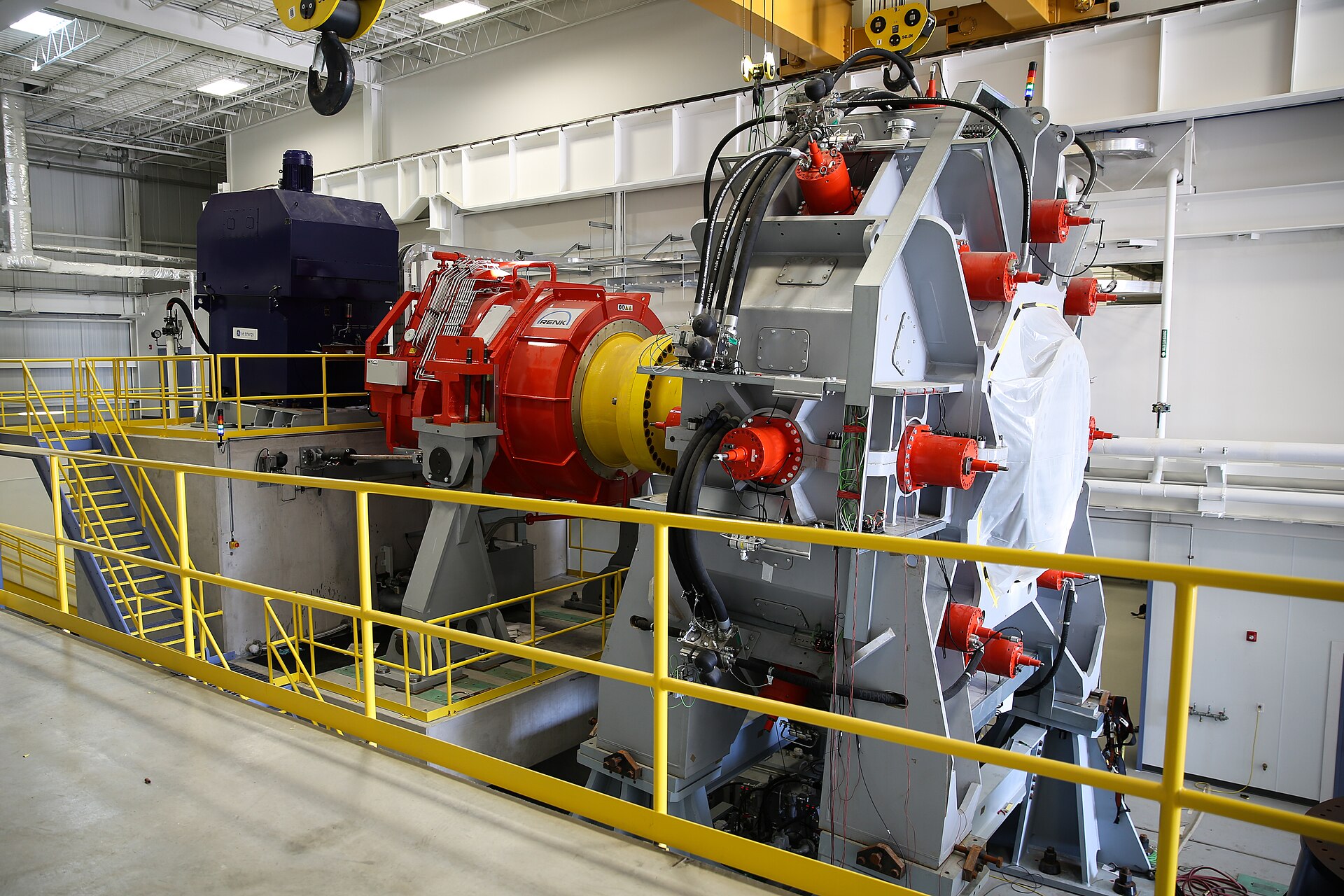
Image credit: Photo: North Charleston, Clemson University wind turbine drivetrain testing facility, via Wikimedia Commons, licensed CC BY-SA 2.0 (https://creativecommons.org/licenses/by-sa/2.0/). Source: Photo: North Charleston, Clemson University wind turbine drivetrain testing facility, via Wikimedia Commons, licensed CC BY-SA 2.0 (https://creativecommons.org/licenses/by-sa/2.0/).