Wind Technology Database: the pilot shortlist checklist for offshore wind innovation teams
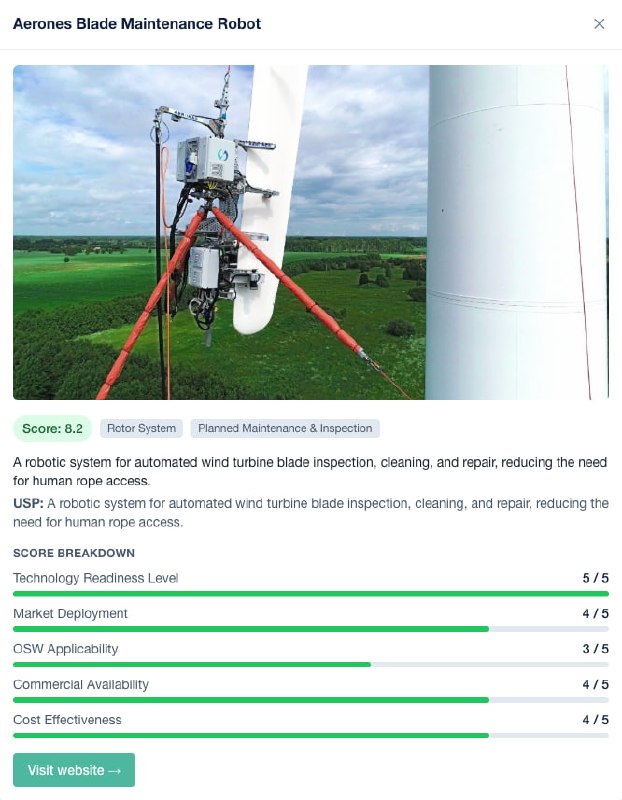
TL;DR: Innovation teams lose time when every innovation challenge starts from a fresh technology longlist. Pelergy's Wind Technology Database is designed to shorten that cycle with four gates: operating problem, evidence tier, deployment fit, and procurement readiness. The method reflects the same filtering discipline Pelergy used successfully for 15 years with clients. It is proven to help offshore technology businesses move from prototype to commercial traction.
Why this matters
Innovation managers are under pressure from both sides. Operations teams want tools that work in real offshore conditions. Procurement and leadership teams want an evidence trail they can defend. The gap between those two demands is where a lot of pilot programmes stall.
That is the job the Wind Energy Technology Database is meant to do. It gives teams a structured way to move from market noise to a shortlist that can survive technical review, budget scrutiny, and internal sign-off.
What the Wind Technology Database should solve
The problem is rarely access to ideas. Most offshore wind teams can find robotics, inspection, monitoring, and access technologies quickly enough. The harder part is deciding which ones deserve attention now.
Pelergy sees the same four questions show up again and again in technology scouting, due diligence, and commercialisation work:
1. What operating problem does this solve? 2. What evidence exists beyond a slide deck? 3. Can it work in the site, vessel, and workflow conditions that matter? 4. Can the supplier support a pilot and the steps after it?
A database only becomes commercially useful when it helps teams answer those questions faster, with fewer weak candidates making it into meetings.
The four-gate shortlist method
1. Start with the operating problem
Start with the operational pain point rather than the technology category. Blade inspection delays, access constraints, cable monitoring gaps, and vessel-day pressure need different search logic. If the problem statement is vague, the shortlist will be vague as well.
2. Check the evidence
This is where many pilots drift. Teams mix together lab results, sheltered-water trials, and real operating proof as if they carry the same weight. A useful database separates concept evidence from field evidence and commercial use, and has already pre-qualified which technology fields the solution could come from. Is it a sensors challenge? Is it a robotics challenge? etc.
3. Screen for deployment fit
A promising system can still fail the shortlist if it depends on the wrong vessel class, unrealistic weather windows, awkward data integration, or a crew process that will never be adopted. This gate keeps operational reality in the room early.
4. Test procurement readiness
Pilot success depends on more than technical performance. Supplier capacity, documentation quality, certification progress, and contracting readiness all affect whether the pilot happens on time. This is usually the difference between a shortlist and a wish list.
Evidence from Pelergy projects
Pelergy built this thinking from 15 years of delivering projects for clients.
In one global technology scouting programme of work for Sturrock and Robson, focused on offshore wind servicing, Pelergy reviewed more than 200 technologies across subsea inspection and remedial works markets and narrowed the field to 20 candidates for direct engagement. The commercial value came from a filter that removed noise and made the shortlist defensible.
Through work for Innovate UK Business Connect, Pelergy set up and now supports the operation of the Innovation eXchange (iX). Over the last 10 years, we have delivered support to 500+ companies and brokered more than 30 industrial challenges in offshore wind, and the programme has delivered just shy of 300 challenges in other sectors. Pelergy has seen how quickly a broad search becomes unmanageable when evidence standards are weak or the buyer problem is not defined tightly enough.
A checklist innovation teams can use now
Before a technology reaches pilot discussion, ask:
• Is the operating problem precise enough to measure success?
• What is the highest verified evidence tier so far?
• What site, vessel, HSE, and data constraints could block deployment?
• What technology types fit this challenge?
• Can the supplier support procurement, documentation, and follow-on delivery?
• If this works, what is the path beyond the pilot?
If one of those answers is weak, the technology probably needs more work before it reaches the shortlist.
Trade-offs and limits
A database will not remove judgment or tell a team when to take a calculated risk on an early technology. What it does is make the evidence gaps more visible, which is often the real bottleneck in internal decision-making. That matters even more as innovation teams work through larger turbines, tighter access windows, and a wider mix of robotics and digital tooling. The next advantage will come from better filtering discipline and a better understanding of technology fields, and we can help with that.
Conclusion
The Wind Energy Technology Database is useful when it helps teams carry less of a manual scouting workload and make better pilot decisions faster. That is the commercial bridge: stronger shortlists, cleaner internal sign-off, and fewer wasted pilot cycles.
If your team is building a 2026 innovation pipeline, explore the Wind Energy Technology Database or read Pelergy's earlier piece on offshore wind technology scouting.
Image credit: Pelergy. Source: Pelergy.