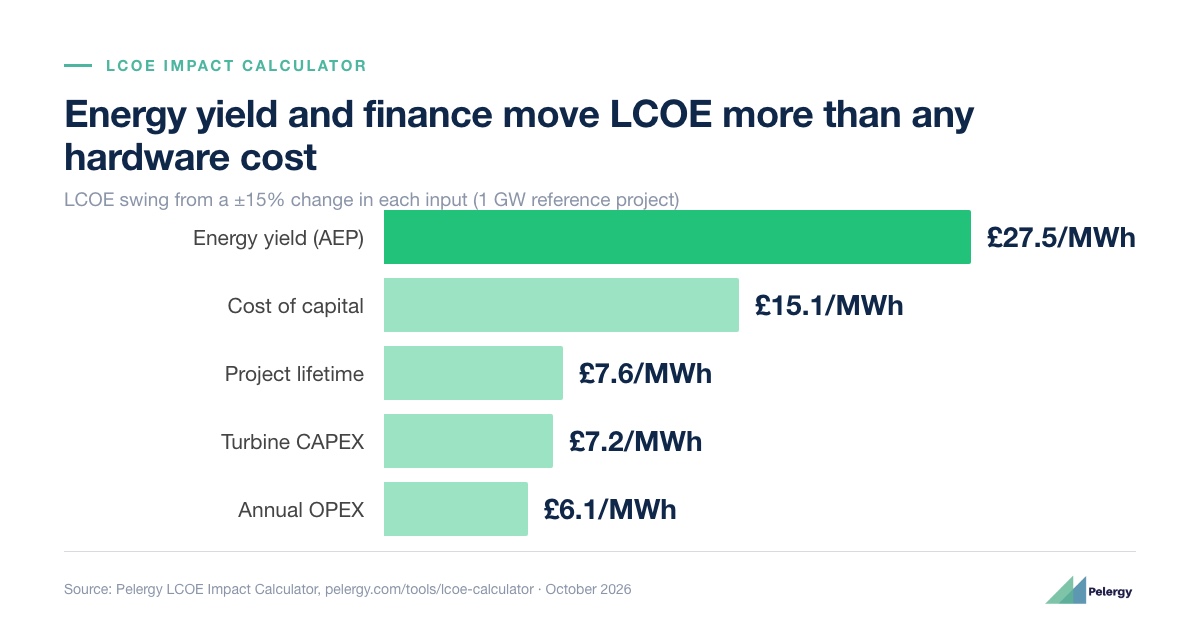
Technology-driven LCOE changes under explicit assumptions
Pelergy used marine-operations modelling to validate levelised cost of energy (LCOE) reduction claims for a crane-less wind-turbine installation innovator working with 20MW+ turbines. The innovator needed a business plan for a £1m seed round and a government grant. Pelergy produced an investor-ready business plan alongside the modelling.
The project connected a claim about a technology to an operational question: what changes when a developer uses the installation technology? An LCOE result depends on the assumptions that translate that change into expenditure, timing and energy production.
For a technology company seeking funding, the useful result identifies which assumptions support the investment case. For a developer or operator, the useful result identifies which assumptions need verification before a procurement or deployment decision.
LCOE changes depend on costs, timing and energy production
LCOE expresses project costs over its lifetime relative to the electricity produced, with discounting accounting for when costs and generation occur. A technology affects that result through specific changes to the model.
The analyst identifies the affected cost categories:
- Capital expenditure (CAPEX) covers the investment required to build and commission the project.
- Operating expenditure (OPEX) covers the recurring costs of operating and maintaining the project.
- Major component replacement (MCR) covers replacement events that may require equipment and marine expenditure.
Cost timing also matters. CAPEX phasing describes when construction expenditure occurs. OPEX escalation describes how operating costs increase over time. Replacement timing determines when a major intervention enters the lifetime calculation.
A lower installation cost and an earlier installation payment affect the calculation differently. An operating-cost saving also depends on when the saving begins and how the model escalates the underlying cost.
The technology assumption therefore needs an operational explanation. For an installation technology, that explanation might concern vessel requirements, task duration or access conditions. Each proposed change needs evidence before the analyst assigns a saving.
Five evidence checks connect a technology claim to LCOE
A practical evidence gate, a set of checks before accepting a modelled benefit, gives technology teams and developers a common basis for reviewing assumptions:
- The baseline represents a specified project. The analyst records the turbine configuration, installation approach, operating assumptions and project lifetime. The technology case uses the same basis unless evidence supports a change.
- The technology changes a named input. The analyst identifies the affected CAPEX, OPEX, MCR, energy-production or timing assumption. A claim about faster installation needs a corresponding change in the installation calculation.
- The evidence supports the size of the change. The technology team identifies whether each assumption comes from a quotation, test, operating record or model. The analyst records the conditions under which that evidence applies.
- The calculation includes associated costs. The developer and technology team check whether deployment introduces equipment, integration, training or maintenance requirements. Any included allowance needs an explanation and a source.
- The result survives a stated sensitivity test. The analyst varies uncertain assumptions and records how the LCOE result responds. The developer identifies which tested conditions remain relevant to the intended project.
The installation case illustrates the link between a technology proposition and operational modelling: Pelergy used marine-operations modelling to validate the innovator's LCOE reduction claims. The supplied project evidence does not quantify the reduction, so this account reports no percentage saving.
LCOE results remain conditional on their evidence
A modelled saving applies within the conditions represented by the inputs. A developer considering a different turbine configuration, vessel arrangement or operating environment needs evidence that the technology assumption transfers to that project.
For example, evidence supporting an installation-duration assumption does not automatically establish a maintenance-cost reduction. The analyst needs separate support for each affected input.
Double counting also needs review. If an installation-cost estimate already includes vessel time, adding a separate vessel-time saving may count the same benefit twice. The analyst needs to trace each saving through the calculation.
Commercial evidence matters alongside engineering evidence. In a separate acquisition assignment, Pelergy assessed vessel-fleet viability, customer concentration and technology threats for a corporate investor evaluating an established subsea services business. Pelergy's commercial due diligence illustrates the operational and market questions surrounding an investment decision.
Explicit LCOE assumptions focus the next commercial decision
A technology company gains a clearer funding proposition when the model identifies the evidence required to support each claimed benefit. A developer gains a defined basis for deciding which assumptions require supplier confirmation, further modelling or a trial.
If the result depends heavily on an installation-duration assumption, the next commercial discussion concerns evidence for that duration under the proposed project conditions. If replacement costs determine the result, the discussion concerns replacement requirements and their timing.
Pelergy's LCOE Impact Calculator quantifies technology impacts with CAPEX phasing, OPEX escalation, MCR modelling and sensitivity analysis. Evaluate a technology's cost-of-energy assumptions with the LCOE Impact Calculator.
Image credit: Photo: Matt Artz on Unsplash. Source: Photo: Matt Artz on Unsplash.